I like digital notes. I like search, links, full-text retrieval, and the possibility that an AI system can help me find the thread I forgot I was carrying.
I also keep reaching for paper.
That is not a technology contradiction. It is a memory design choice.
Digital is fast. Physical is sticky.
Digital notes win when I need breadth: search across years, connect a source to a project, copy a useful passage into a draft, or compare several decisions at once.
Paper often wins at the moment of thinking. The page has a place. The mark has a shape. A diagram can stay messy long enough for the relationship to become visible. A margin can hold the question I do not yet know how to phrase.
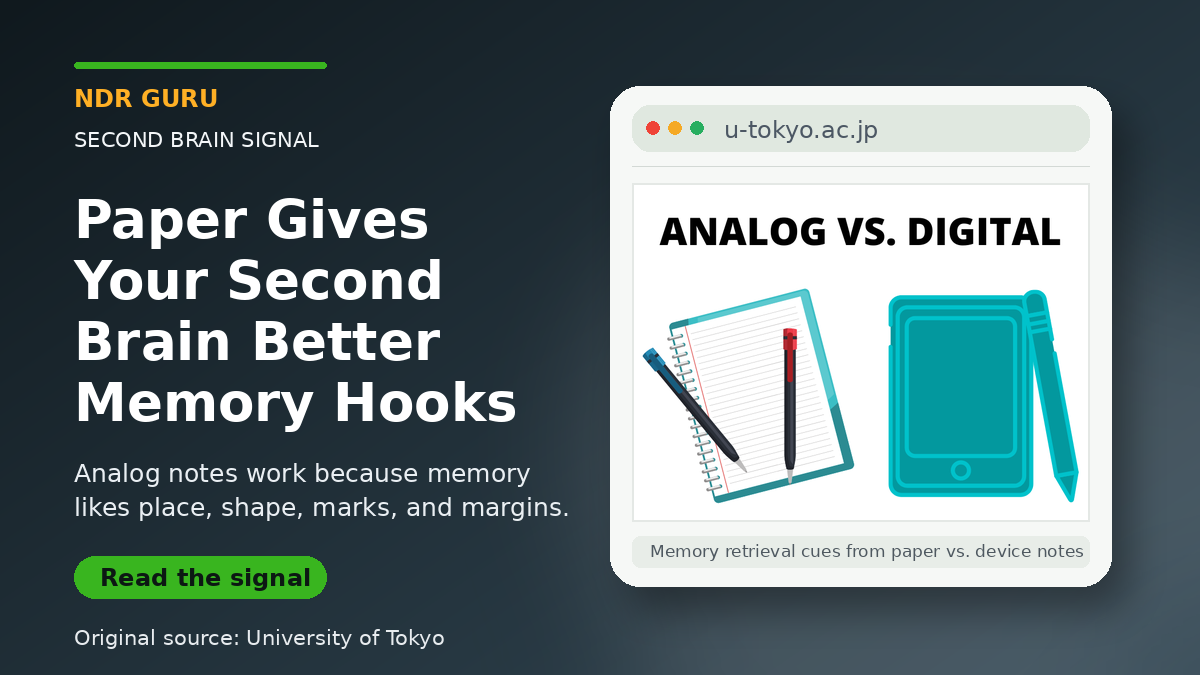
The useful lesson is not “paper is better.” It is that memory is helped by more than words. Location, movement, visual arrangement, and the physical act of making a mark can give an idea another route back into view.
Do not flatten every input into text
One of the easy mistakes in an AI Second Brain is assuming that every useful thing should become a clean paragraph.
Sometimes the photograph is the note. Sometimes the voice memo preserves the uncertainty better than a polished transcript. Sometimes the rough sketch shows the system more honestly than a list of nouns.
The job of the digital system is not to erase those forms. It is to keep enough of their meaning and make them findable again.
A hybrid workflow that survives real life
Here is the simple version I keep coming back to:
1. Think in the format that gives the idea the most life. 2. Add a short context note while you still remember why it matters. 3. Photograph, scan, or attach the original artifact. 4. Link it to a live project, question, or person. 5. Let AI help with transcription, comparison, or resurfacing. 6. Keep the original available when the detail matters.
The AI layer gets more trustworthy when it can point back to the actual thing instead of pretending its summary is the whole memory.
The test is not neatness
A beautiful notebook that never re-enters your work is a keepsake. A messy page that helps you solve the right problem is part of a Second Brain.
The same goes for apps. The best tool is not the one with the most features. It is the one that helps you return to context, make a decision, and finish without creating a new ritual every week.
Related: The Best Second Brain Is Not Only Text.
For a broader research frame on personal information management, see this overview of Personal Information Management.