There is a useful moment before an idea becomes an article, a plan, a project, or a task.
It is the moment when the idea is real enough to bother you, but not clear enough to use yet.
You can feel it moving around. You know there is something there. You may even know the general shape of the outcome. But the idea is still too foggy to act on.
That is when the right prompt is not "give me an answer."
It is closer to this:
"There's an idea rattling around in here somewhere. Help me get it on the table so I can look at it."
That line is a better description of AI-assisted thinking than most polished productivity language.
Sometimes the most useful thing AI can do is not originate the idea. It can help you see your own idea clearly enough to do something with it.
Before the answer
A lot of AI use gets framed around output.
Write the post. Summarize the document. Generate the plan. Make the list. Draft the email.
Those uses are real, and sometimes they are useful. But they skip over one of the more interesting places where AI fits into knowledge work: the messy middle before you know what the output should be.
That is where many good ideas actually live for a while.
You have a hunch. You have a sentence fragment. You have a photo, a note, a memory, a conversation, or a half-explained pattern. You do not need the machine to pretend it is brilliant. You need a surface.
You need somewhere to put the thought down so you can turn it around.
That is the thinking-partner version of AI. It asks back. It reflects. It sorts. It names the pieces without stealing ownership of them. It helps you move from "there is something here" to "now I can see the shape of it."
Marginalia is an older version of this
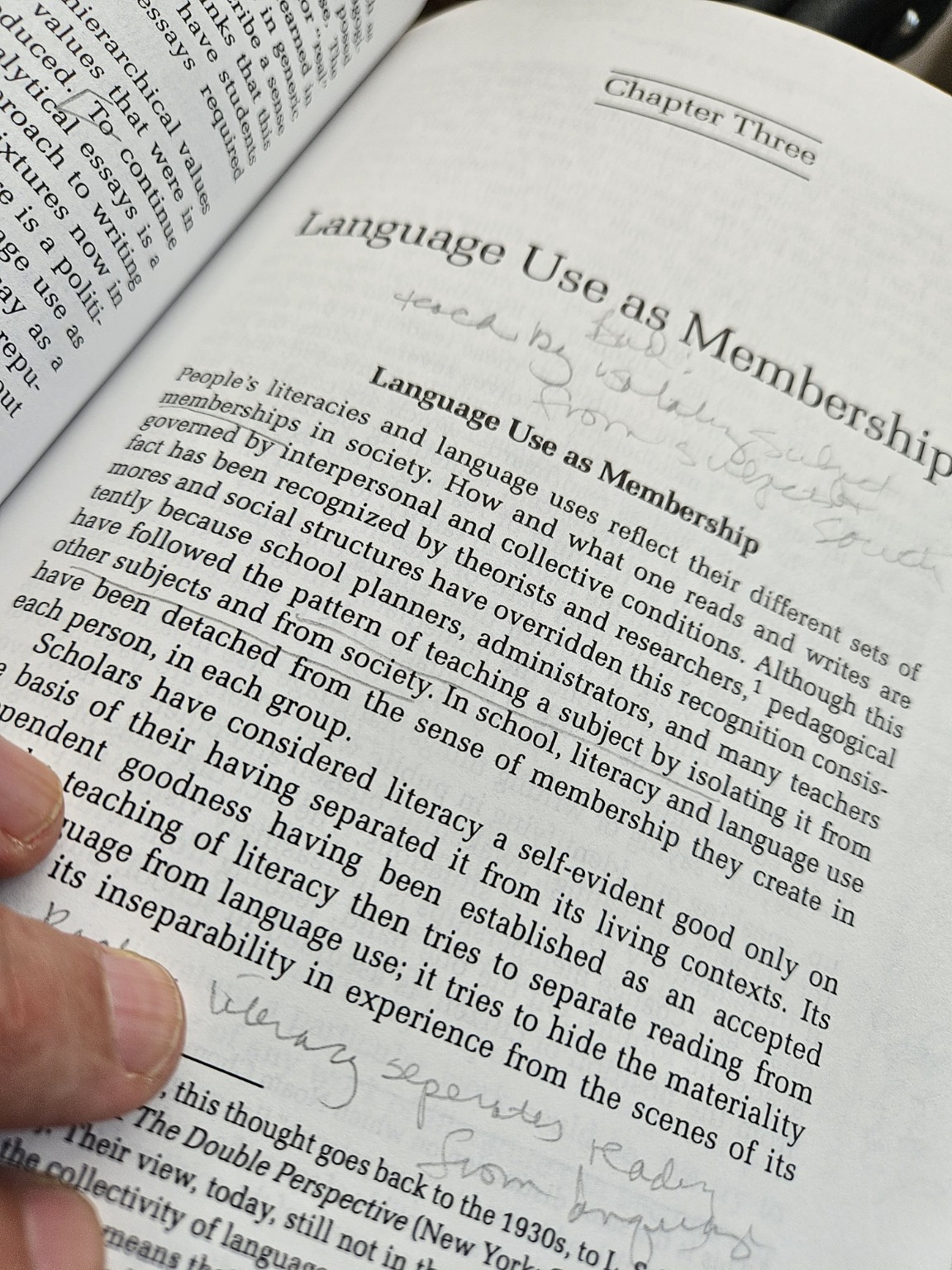
The source image for this piece is simple: an open book chapter titled "Language Use as Membership" with handwritten notes in and around the page.
I am not going to pretend to know the full story of the handwriting. That would be the wrong move. The useful signal is not a made-up biography of whoever wrote in the book.
The useful signal is that someone used the page as a thinking surface.
A book already contains words. Marginalia adds another layer: underlines, comments, reactions, connections, objections, reminders, maybe a question the reader wanted to keep alive. The printed page becomes a place where the reader's mind leaves tracks.
That is not just annotation. It is externalized thought.
The idea is no longer trapped inside the reader's head. It has become visible enough to revisit.
That is why notes matter. Not because every note is profound. Most notes are not. Notes matter because they give thought a body. They let you return to a moment of attention and ask, "What was I seeing here?"
AI can be conversational marginalia
When AI is used well in this part of the process, it behaves less like an answer machine and more like conversational marginalia.
It gives the thought somewhere to land.
You say the awkward version first. The assistant reflects it back in cleaner language. You disagree with the cleaner version because it is too neat. That disagreement is useful. Now you know what the idea is not.
You ask for possible angles. Some are wrong. A few are close. One phrase suddenly names the thing that had been bothering you.
That is not outsourcing thinking. That is making thinking inspectable.
The danger, of course, is flattening. AI can sand the weird edges off a thought before you understand why those edges matter. It can turn a live idea into familiar mush: "AI is changing everything," "content is king," "productivity in the modern age," and other phrases that sound like they came shrink-wrapped.
So the job is not to let AI replace the mess.
The job is to let AI help you work with the mess without losing the human signal inside it.
A second brain should preserve the signal
This is where the second-brain lesson shows up.
A weak second brain captures text and calls the job done.
A stronger second brain preserves enough context for you to re-enter the thought later.
That context might include:
- the original photo
- the phrase that started the idea
- the project or question it belongs to
- the conversation that clarified it
- the draft that emerged from it
- the decision or next action it produced
The phrase for this Long Coffee Trips experiment was:
Not just photos. Signals.
That is a good rule for notes, too.
A photo of marginalia is not only a picture of a page. It is a signal about how people think with artifacts. A rough prompt is not only a request for output. It is a signal that an idea is trying to become visible. A conversation with AI is not only a transcript. It can be a record of thought becoming organized.
If the system only stores the finished article, it loses the path.
If it stores the source, the notes, the conversation, and the draft, it gives future-you more ways back in.
The practical move
The next time an idea is bothering you, do not start by asking AI for the finished thing.
Start earlier.
Try something like:
- "I think there is an argument here, but I cannot see it yet."
- "Reflect this back to me without making it generic."
- "What are three different questions this source material could answer?"
- "What part of this sounds like the real idea?"
- "Help me separate the signal from the decoration."
- "What would I need to know before turning this into a task?"
Then argue with the response.
Circle the part that feels alive. Delete the part that sounds borrowed. Ask again. Make the idea a little more visible.
That is the work.
Not because AI magically knows what you mean, but because the exchange gives your own thinking resistance, shape, and a place to stand.
The idea on the table
The best notes are not only records. They are working surfaces.
The same is true of the best AI conversations.
The goal is not to ask the machine to think for you. The goal is to get the idea out where you can inspect it, question it, connect it, reshape it, and decide what happens next.
Sometimes that becomes an article.
Sometimes it becomes a project.
Sometimes it becomes one sentence you needed to see in order to move.
That is enough.
The idea was rattling around in there somewhere. Now it is on the table.