I have become suspicious of any note system that makes me feel accomplished before it has helped me do anything.
Capture is satisfying. You save the article, clip the quote, file the meeting note, and give the new idea a respectable home. It feels like you are taking care of future-you.
Sometimes you are. Sometimes you are just building a very well-labeled attic.
Tiago Forte's CODE method—Capture, Organize, Distill, Express—and PARA—Projects, Areas, Resources, Archives—are useful because they give knowledge workers a way to get out of the blank-page problem. You do not have to invent a filing system every time a useful thought appears.
But the filing system is not the finish line. The real test is return.
The note has a job after you save it
A note becomes valuable when it comes back with enough context to change something. It might improve a decision, reopen a useful question, shorten a draft, remind you why a project exists, or help you avoid repeating an old mistake.
That means the note needs more than content. It needs handles:
- what problem it belongs to
- why it mattered when you saved it
- what it connects to
- what would make it useful later
- where the original source came from
Without those handles, search can find the words but not necessarily the reason.
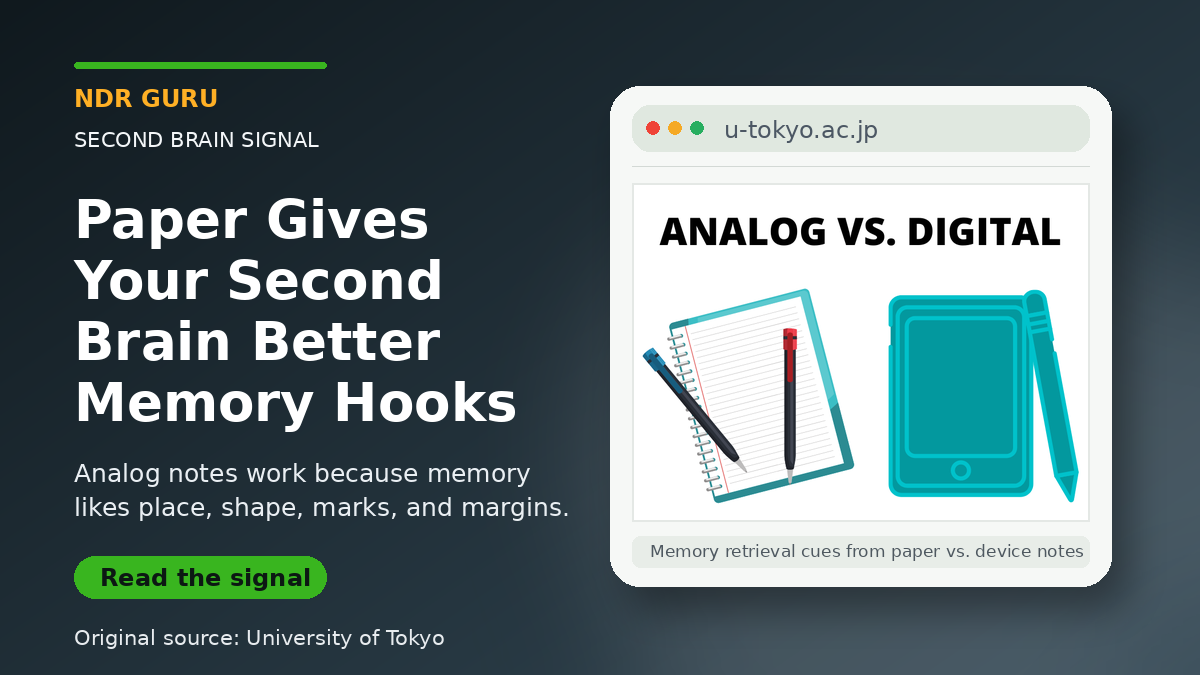
The analog-versus-digital comparison in this image is a good reminder. Paper has physical cues: where the note sits, what the page looks like, what is written in the margin. Digital systems have speed and reach. Neither is automatically the better memory. The useful question is which cues help you return.
PARA is a map, not a personality test
I like PARA most when it stays lightweight. A project folder should help me find the work that is alive now. An area should remind me what I am responsible for. A resource should give a topic somewhere to wait without pretending it is urgent.
The trouble starts when the structure becomes more important than the work. If I spend an afternoon debating whether a note belongs in Resources or Areas and never use the note, I have confused organization with thinking.
The best structure is the one that lowers the cost of the next return.
The return question
For every note worth keeping, I want to be able to answer one plain question:
When might this help me again?
The answer does not need to be precise. “When I write about local-first AI,” “when I revisit this product decision,” or “when I explain this to someone new” is already better than a dead tag cloud.
This is also where AI can help. Ask it to surface related notes, compare old and new thinking, or show you where a saved source touches a current project. Do not ask it to pretend the connection is important just because it can describe one.
A small test for this week
Open ten old notes. Do not reorganize them. Pick the three that still have a pulse.
For each one, add a sentence saying where it could help now. Link it to a live project, a person, a question, or a decision. Archive the rest without guilt.
That is a better second-brain exercise than building another dashboard.
Related: Capture vs. Retrieval: The Balance That Makes a Second Brain Useful.
For the original framework, see Building a Second Brain and the PARA method.
---